Archive for January, 2006

Direct sales

Monday, January 16th, 2006

I’ve been making games for 13 years now. But I just had a first over the weekend – my first direct sale (sorta).

‘Til now, I’ve never cashed a check or received money directly from a customer. I’ve always used publishers, and there has generally always been at least one more middleman down the line – either the retailer or, now for Bonnie’s Bookstore, the portal.

I signed Bonnie’s Bookstore with PopCap as a publisher, and they’ve done an excellent job getting it on to the major portal (just added RealArcade last week), as well as selling from their own site. But in my agreement with PopCap, I retained the right to sell the game from my own site (as many casual game developers who sign with publishers do).

On Friday afternoon, I finally finished setting up my account with Plimus, an on-line transaction provider catering to online software sellers. And over the weekend, I had my first sale, to John XXXX of Brisbane Australia – thanks John!

It’s only sort of a direct sale, as I guess Plimus is still a middleman. But as an order processor, they only take 10% of the revenue, so I should make about $18 off of this $20 sale. $18 is way way more than I’ve ever made per unit via any other distribution arrangement I’ve had. That said, I’ll be surprised if direct sales from my website constitute even as much as 1% of my sales over the next year – but I’ll be curious to watch them.

For the record, I’ve had 103 downloads in the last 3 days – about 40% of the people who visit www.newcrayon.com download the game. Now if only I can sell a second copy, I’ll double my conversion rate 🙂

Here’s the traffic to the New Crayon site over the last 3 months. Bonnie’s Bookstore was first released to the PopCap mailing list at the beginning of December – that’s the first spike. A week later, it started to go ‘wide’ – first to PopCap’s general site, then other sites. So far, I’ve done no marketing myself, so this traffic is basically organic. Not substantial enough to build a business on or even have a material effect as a secondary revenue stream, but we’ll see what happens over the next year…
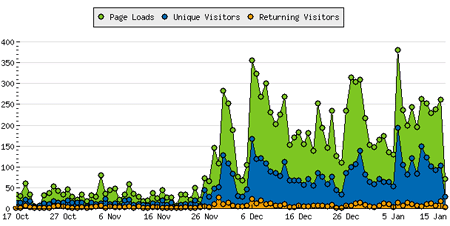
New Crayon's web traffic

The Difference Between Goofing Off And…

Friday, January 13th, 2006

The difference between goofing off and game design may appear subtle to an outsider. Especially when you’re at the concept stage, trying to figure out what type of game to make, let alone the specifics of the game.

Here’s how a well-trained outsider can tell the difference.

Someone who’s goofing off alternates between downloading demos from RealArcade and playing games that like Ticket to Ride, that, while fun, aren’t very applicable to traditional casual games.

Someone who’s a professional game designer also alternates between downloading demos from RealArcade and playing games that like Ticket to Ride, that, while fun, aren’t very applicable to traditional casual games. But every now and then he jots down some random ideas in a yellow notepad, before balling up the paper a bit later and tossing it out.

Link o’ the day

Experimental Gameplay Project – a bunch of college kids knock out 50 goofy, but often fun game mechanics in the course of a semester. Check out the Tower of Goo!

(Oh, but I was researching it, not goofing off. Just in case anyone asks, you know…)

CasualGameBlogs.com

Thursday, January 12th, 2006

I’ve set up a new blog aggregator here:

www.casualgameblogs.com

My goal is to have it be a nice one-stop shop for browsing casual and/or indie game blogs, both developer and review/news blogs.

If you have a blog or other RSS feed you’d like to recommend for the site, please PM me.

Interviews

Wednesday, January 11th, 2006

Gamecloud has an interview with me about New Crayon Games, Bonnie’s Bookstore, my old company (PopTop Software) and other topics.

They also have an interview with Jason Kapalka and James Gwertzman of PopCap, my current publisher, about the history of that company.  Jason and James are both great guys who I worked closely with on Bonnie’s.

Casual Game Price Points and Conversion

Monday, January 9th, 2006

There’s a good interview here with C.J. Wolf of iWin, discussing some experiments they did with pricing for their casual game Family Feud. It’s rare in this biz to see any hard data on conversion rates, so it’s particularly cool to see not only F.F.’s conversion rate data, but the results of their experiment on how the C.R. was affected by price point.

The standard for this biz is $19.95, with a 60 minute free trial.

Apparently, they first tinkered with the length of the trial period. At 60 minutes (and a $19.95 price point), the game had a conversion rate of 0.9%, but the conversion rate went up to 1.3% when they cut the free trial period to 30 minutes.

Next, they experimented with price (I’m assuming these results were with the 30 minute trial period, though that’s not explicitly stated):

_________Conversion________
Price_______Rate______Yield
$19.95______1.3%_______$.26
$24.95______1.1%_______$.27
$29.95______1.1%_______$.32

The conversion rate is sales per completed download. The yield is revenue per completed download – i.e. the product of the prior two columns.

As you can see, though C.R. slipped a bit at the higher price point, it was more than offset by the higher price point.

I’m not sure that these results would hold with the majority of casual games. F.F. is a bit of an outlier in several respects.

First, it’s an established brand that people are familiar with, and there’s no way for a consumer to buy an equivalent product from someone else for less money. i.e. they don’t face competitive price pressure from others at $20.

Moreover, consumers might be more comfortable with both the shorter trial period and the higher price point given the familiarity of the underlying license (and game mechanics).

Finally, I’ve played iWin’s version of F.F., and frankly, there’s not a lot there. Yes, they recreate the game reasonably faithfully, and I do enjoy the television show, but the game gets repetitive and boring quickly. I stopped playing after 20 minutes. So a shorter trial period probably makes sense. But for a game with a longer backstory and more varied gameplay, I think you might more effectively hook the consumer with the traditional 60 minute trial. I’d love to see others experiment with this and publicly reveal their data.